
Smartphones About to Make Leap, Carry Basic Senses

VoiceOfAmerica-Logo
George Putic

Long-distance communication contains mostly sounds and pictures. For now. But scientists in Britain say they are close to creating additions for our smartphones that will make it possible to send taste, smell and even a basic touch.

Many people around the world enjoy one of the greatest marvels of modern technology every day — instant audio-visual communication.

But professor Adrian David Cheok, from City University in London, said he wants to transcend what he calls the ‘glass barrier’.

“In the real world, we can open up the glass, open the window. We can touch, we can taste, we can smell in the real world,” said Cheok.

Mobile taste

Let’s start with the sense of taste. Cheok said different tastes are triggered by molecules that cause chemical ionization on the surface of the tongue, sending the brain electrical signals of a specific amplitude and frequency that are possible to reproduce with two electrodes.

“You put these two silver electrodes in your mouth, you put your tongue in between and then it stimulates electrically your tongue and you get a virtual taste perception in your brain,” he said.

So far, scientists have reproduced sour, salty, sweet and bitter tastes.

Another device, called ‘Scentee,’ plugs into a smartphone, and can spray tiny clouds of selected fragrances, such as lavender or jasmine, smells of fruits or even coffee, when prompted by the other side of the conversation.

“Basically what happens, we have an app, it connects to the Internet and then this will release scent from your mobile phone,” said Cheok.

Long-distance smell, touch

Scentee holds a cartridge with about 100 different smells, but has to be replaced once it’s been used up.

The sense of touch comes through a ring-like device. Connected wirelessly to the smartphone, it transmits a gentle squeeze when the other person does the same during a conversation.

“I can be in London and my friend can be in Tokyo, and I can squeeze my finger and then they’ll get a squeeze on their finger through the Internet. It’s a way of touch communication with small mobile devices,” said Cheok.

Cheok said he hopes devices such as these will someday be added to smartphones and even smart houses, transcending the current limitations of long-distance communication.


http://www.voanews.com/content/smartphones-to-carry-basic-sense-of-smell-taste-and-touch/2617420.html

Wake up and smell the message

Sunday, January 18, 2015, 00:01

times_of_malta

The sense of smell is the next frontier for smartphones.

technology_07_0_temp-1421671251-54bcfb53-620x348

One of technology’s modern truisms is that if you can imagine it, there’s an app for it. Do you want to book a table for dinner, spy on your neighbour, fool your colleagues into thinking that you’re busy working when in fact you’re taking a nap (iNap@Work), check if a watermelon is actually ripe by analysing the sound it makes (Melon Meter), and pop a virtual pimple? Yes, there’s an app for all that and more.

It is this sheer availability of apps that has transformed phones from a device for calling and sending messages into a tool that can help you do anything you want, and then some more.

There’s just one sense which no app has managed to captureyet: smell.

As the humblest of senses, smell is frequently underrated. And yet, without smell, food would taste different because while taste can distinguish between sweet, salty, sour, bitter and savoury, it is the interaction between taste and smell which cooks up the real flavour of food. Without smell, you wouldn’t enjoy the dark pleasure of a freshly brewed early morning coffee. And no wardrobe is complete without a quick dash of perfume behind the ears.

Smell is the next frontier for smartphones. And we’re getting there. In 2013, chef Ferran Adria hosted a webcast in which he invited academics and developers to submit proposals to help him create an online gastronomic resource: Bullipedia. One of the shortlisted proposals, put together by Professor Adrian Cheok, founder and director of Singapore’s Mixed Reality Lab, has now been commercially developed by Japanese firm ChatPerf into Scentee.

Working in conjunction with a dedicated app, Scentee is a module that can be slotted into a smartphone’s headphone jack. The module then emits scentson command.

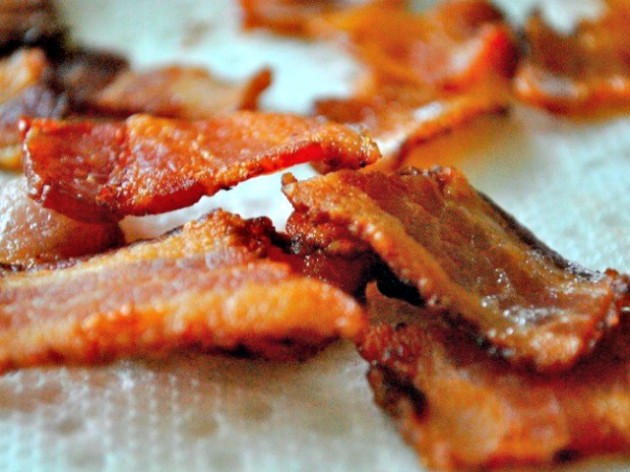
It’s still early days for Scentee. However, it carries huge potential, especially for marketing and gaming purposes. In the US, bacon company Oscar Meyer has come up with an alarm clock which, when attached to your smartphone, wakes you up with the smell of sizzling bacon. How’s that for a good morning? And even though Scentee might have failed to win favour with Ferran Adria, another Michelin-starred restaurant, Mugaritz in San Sebastian, Spain, is using the app as a pre-dinner treat for customers.

The Scentee code has also been released, which means that developers can write their own scent-based apps. The Parisian design centre Le Laboratoire is also developing its own smell device: the oPhone. The device, which will be available this spring, is a phone that emits various smells to music and at the time of its release, will be able to emit 300,000 unique smells. This means that, for instance, instead of traditional messages, friends with oPhones can send each other smells: just imagine waking up your wife with the smell of coffee or sending a rose-scented message to a date.

Smell-centred communication has other potential applications. Digital olfaction can fuel healthcare applications: researchers are studying the possibility of using an e-nose to deliver early diagnosis of cancer through chemicals in the blood. Smelling devices can also be used as a cognitive aid for Alzheimer’s sufferers and to detect chemical offgassing from hidden weapons.

Before you rush off to compose a smell to send to your friend, remember that smell-centred communication is still in its early stages. But give it a couple of years and sending and receiving smells could be as normal as transmitting sight and sound.

http://www.timesofmalta.com/articles/view/20150118/technology/Wake-up-and-smell-the-message.552536

Watch BBC Royal Institution Christmas Lectures 2014: Sparks Will Fly – How to Hack your Home

logo    bbc-blocks-dark

Royal Institution Christmas Lectures 2014: Sparks Will Fly – How to Hack your Home
Episode 2 of 3 – Making Contact

RI_lectures3

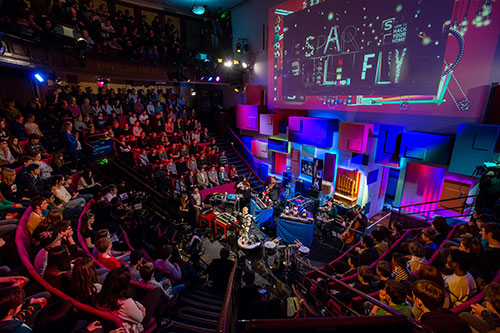
Professor Danielle George takes three great British inventions – the light bulb, the telephone and the motor – and shows you how to hack, adapt and transform them to do extraordinary things. This is tinkering for the 21st century.

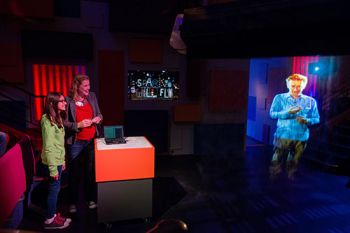
Inspired by Alexander Graham Bell, Danielle attempts to beam a special guest into the theatre via hologram using the technology found in a mobile phone. Along the way, Danielle shows the next generation how to hack, adapt and transform the electronics found in the home to have fun and make a difference to the world.

This year’s Royal Institution Christmas Lectures have been inspired by the great inventors and the thousands of people playing with technology at their kitchen tables or tinkering in their garden sheds. When Scottish inventor Alexander Graham Bell demonstrated the first telephone in 1876, he could never have dreamed that in 2014 we’d all be carrying wire-free phones in our pockets and be able to video chat in crystal clear HD across the world.

featured (1)

In this lecture, Danielle explains how these technologies work and shows how they can be adapted to help keep you connected to the people around you. She shows how to control paintball guns with a webcam and turn your smartphone into a microscope, whilst also investigating a device that allows you to feel invisible objects in mid-air.

featured (2)

Watch full episode: http://www.bbc.co.uk/programmes/b04wlv8r

SCENT TECHNOLOGY: SWEET OR STINKER IN 2015?

breitbart-california-logo

by MICHELLE MOONS 20 Dec 2014

Virtual scent seekers in pursuit of that scent-selfie, fragrant floral photo, or a scent to accompany that Instagram food shot may be in luck. Debate continues, however, over whether scent technology will be the next leading tech breakthrough in 2015.

bacon-Flickr-cookbookman17

Technology already exists to send scent digital smells with Japanese application and cell phone attachment Scentee, reports Nesta. Though not yet mainstream, “Scentee uses alcohol-based aroma cartridges which come in specific flavours and are housed inside a small plastic device that attaches to the headphone input of a smartphone.”

New research being developed by Scentee technology creator Adrian Cheok, a professor at City University London, would eliminate the need for those scent cartridges but would employ the possibly undesirable option of a mouthguard device that would send magnetic signals reportedly stimulating the olfactory bulb.

First conceived fifty years back and long considered a stinker, Nesta forecasts scent transmission as one of its top 10 predictions for 2015.

Research has not been waylaid over scent technology naysayers. At the University of California San Diego, researchers released results in 2011 of a two-year experiment regarding adding scents to a television or cell phone experience. Questions remained at the time that continue today as to the widespread appeal of such technology to consumers.

Scent technology-pursuing companies continue in their quest for success. Nesta also brings up oPhone, “a pipe-shaped device made for receiving scent messages (called oNotes) triggered by an iPhone app called oSnap.”

Improvement of scent tech mechanics is also accompanied by the effects of implementing the technology. Nesta reports Professor Cheok and a City University team of researchers have been “studying the effect of synthetic smells, sent via the Internet, on emotions.”

While past opinion has been set against scent tech, researchers continue to put effort into both the mechanics of transmission and the effectiveness-evidence to sell the worth of the product.

http://www.breitbart.com/california/2014/12/20/scent-technology-sweet-or-stinker-in-2015/

City’s Department of Computer Science is prominently featured in the 2014 Royal Institution Lectures

22 December 2014

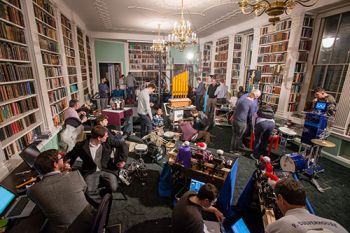
During this year’s distinguished annual event, schoolchildren were treated to a robot orchestra performance and a taste of the electric lollipop developed by City’s Professor Adrian Cheok.

RI_lectures3

City’s Department of Computer Science has played a prominent role in the 2014 Royal Institution (RI) Christmas Lectures, which were presented by Professor Danielle George, with the theme, ‘Sparks Will Fly’. The lectures will be broadcast on BBC Four at 8pm on December 29th, 30th and 31st.

featured

The RI Christmas Lecture Series, regarded as an annual highlight for a science event addressed to young people, is a series of talks on a single topic. The lectures have been held at London’s Royal Institution each year since 1825, except for the period 1939-1942 due to the Second World War.

Michael Faraday initiated the first RI Christmas Lecture Series in 1825 at a time when organised education for young people was scarce. Since then the lectures have followed a tradition of presenting scientific subjects to a general audience in an informative and entertaining manner.

featured (2)

During this year’s RI lectures, opportunities were provided for children in the audience to test out the world’s first electrical lollipop and Scentee smartphone smell app developed by Professor Adrian Cheok’s pervasive computing research team. PhD students Emma Yann Zhang, Gilang Pradana and visiting researcher Shogo Nishiguchi helped to demonstrate the taste and smell devices in the Royal Institution. The lecture will be broadcast on BBC Four on 30th December at 8pm.

featured (1)

Young volunteer Zara Rashid, 11, of Henrietta Barnet School in Hampstead, said:

“I thought the electronic lollipop was really cool, it was hard to work out exactly what the flavour was with just the lollipop but when there was a smell as well that made the taste much sharper. I really enjoyed the Christmas Lectures!”

http://www.city.ac.uk/news/2014/dec/citys-department-of-computer-science-is-prominently-featured-in-the-2014-royal-institution-lectures/