
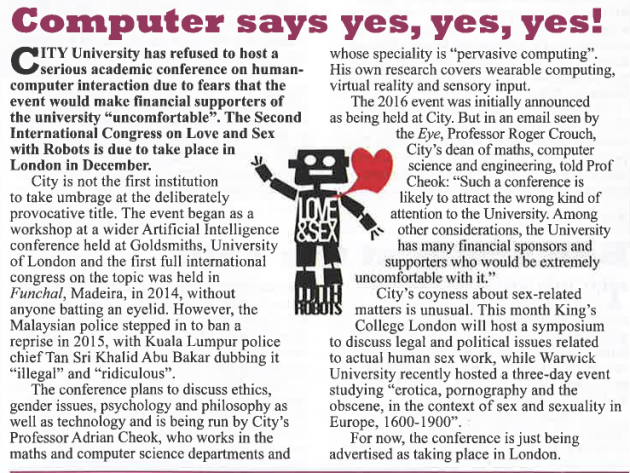
Article in Issue No. 1420 of Private Eye.

The Mixed Reality Lab (MXR) aims to push the boundaries of research into interactive new media technologies through the combination of technology, art, and creativity.
Article in Issue No. 1420 of Private Eye.
Keynote Speaker, Adrian David Cheok, Brainy Tongue Conference, “Sensory Logic of the Gastronomic Brain”, a workshop to explore the interface between neuroscience and cooking, an exceptional hands-on meeting where the world’s leading scientists and chefs will research the mysteries of perception through interactive seminars and sensory experiments. The event will be co-organised by three Spanish entities: the Centre for Genomic Regulation (Barcelona), Mugaritz (San Sebastian) and the Basque Culinary Center (San Sebastián). The meeting will take place at the Basque Culinary Center in autumn of 2016. The workshop aims to bring the together prominent scientists and chefs for two and a half days, in order to generate hypotheses and new principles to be exploited at the dining table.

I recently accepted an invitation to serve as the Guest Editor for a Special Issue of the journal Multimodal Technologies and Interaction on the subject of “Love and Sex with Robots”. It is my pleasure to invite all researchers to submit an article on this topic.
The article may be either a full paper or a communication based on your own research in this area, or may be a focused review article on some aspect of the subject. MTI is an open access, peer-reviewed journal, edited by Professor Adrian David Cheok. You will not be required to pay the usual publication fee (Article Processing Charge) in the first issue of this journal.
All submissions will be subject to peer review. If you plan to submit a review article please provide me with a title and brief description at your earliest convenience, in order to avoid multiple reviews covering the same material.
For more information about the Special Issue, please see: http://www.mdpi.com/journal/mti/special_issues/robots
For information on manuscript preparation and related matters, please see the instructions for authors: http://www.mdpi.com/journal/mti/instructions
Although the deadline for submission of manuscripts to the Special Issue is 1 October 2016, I would appreciate hearing from you in the next few weeks whether you would be willing to submit a contribution.
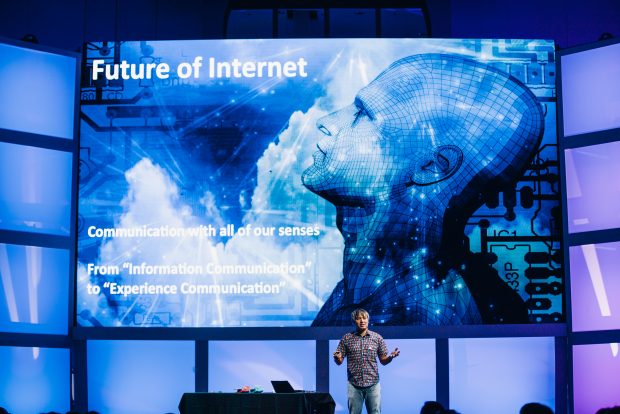
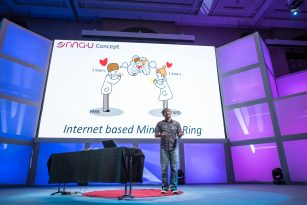


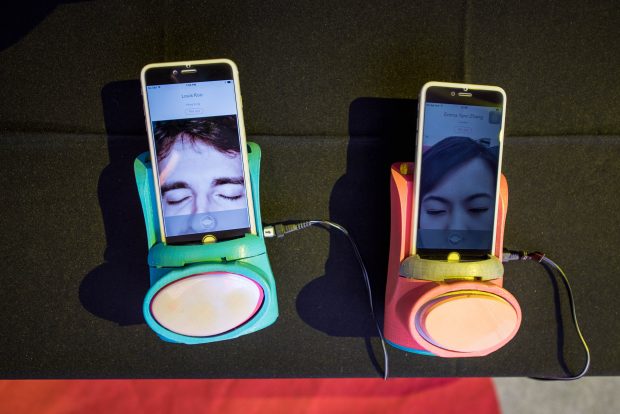
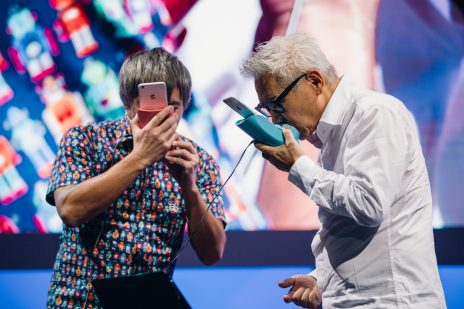
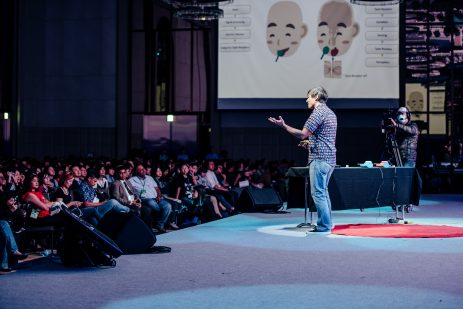

No falta mucho para que algún chef de prestigio mundial -de los de estrellas Michelin, esferificaciones nitrogenadas y platos a 200 euros- comience a enviar sus creaciones por Internet. No hablamos de un servicio a domicilio (¡qué poco glamour!) sino de un envío literal. Es decir, entrar en una web, seleccionar una receta de nombre imposible, conectarse unos sensores y… disfrutar a través de estímulos en tus sentidos del placer de la alta cocina. Tu cerebro interpretará aquello como la más deliciosa de las comidas, aunque en términos nutricionales sea la nada absoluta. Adrian Cheok cree que, al ritmo al que avanzan las nuevas tecnologías, esto será posible en 15 o 20 años. Tal vez menos si los experimentos que su equipo del Imagineering Institute, laboratorio que él mismo dirige, tienen éxito en próximas fechas. De momento ya han conseguido cosas tan asombrosas dentro de este campo como transmitir olores a través de una aplicación móvil, reproducir el sabor dulce mediante un dispositivo que estimula las papilas gustativas o engañar al cerebro haciéndole creer que la cantidad de comida ingerida es mayor que la consumida realmente.
Cheok es uno de los investigadores más importantes del mundo en el terreno de la denominada “realidad mixta”, un concepto que sobrepasa la realidad aumentada y la realidad virtual, puesto que su objetivo es combinar ambos mundos -el físico y el digital- en tiempo real para que puedan convivir e interactuar. El trabajo de Cheok desde el Imagineering Institute es “construir la Internet del futuro” mediante la convergencia de la tecnología, el arte y la creatividad. La idea de transmitir todo tipo de sensaciones a través de Internet se sustenta, según Cheok, en “el deseo de los seres humanos de comunicarse; la tecnología debe orientarse a satisfacer estas necesidades fundamentales, porque es esencial para nuestra felicidad”. Ser feliz, por ejemplo, sintiendo el abrazo o el beso de la persona amada aunque se encuentre a muchos kilómetros de distancia, es uno de los experimentos que ya han llevado a cabo con éxito desde el equipo de Cheok.
Pero sus planes no se detienen en el envío de información digital entre dos seres humanos, por mucho que esto despierte nuestras emociones. Quiere ir mucho más allá: “El siguiente paso es que esa persona no tiene porqué ser real. Puede ser una creación virtual. Tendremos robots o personajes virtuales que serán nuestros amigos y podremos comunicarnos con ellos a través de nuestros cinco sentidos gracias a Internet. La combinación de la inteligencia artificial y la tecnología multisensorial lo hará posible en el futuro. Tendremos amigos e incluso amantes que no serán físicos”.
Texto: José L. Álvarez Cedena