Enhancing My Teaching Skills in 2024: Why eLearning is My Ultimate Solution

Introduction: My Journey as a Modern Teacher

Imagine me, Ms. Johnson, a dedicated elementary school teacher who is passionate about inspiring my students. I know that the world of education is constantly changing, and to stay effective, I must continually improve my skills. In 2024, the quickest and most efficient way for teachers like me to enhance our teaching abilities is through eLearning. Here’s how I sharpen my skills and why eLearning is the best approach.
How I Improve My Teaching Skills

Staying Current with Educational Innovations: The education sector is dynamic, with new technologies and pedagogical methods emerging regularly. I need to keep up with these changes to remain relevant.
What I Do: I regularly read educational journals, attend webinars, and follow influential educators on social media.

Pursuing Professional Development: Engaging in ongoing professional development helps me acquire new skills and refine existing ones.
What I Do: I enroll in workshops, attend educational conferences, and participate in specialized training programs.

Gathering Constructive Feedback: Feedback from peers, supervisors, and students can provide insights into areas needing improvement.
What I Do: I use peer observations and student evaluations to gain different perspectives on my teaching methods.

Collaborating with Other Educators: Sharing experiences and strategies with fellow teachers can lead to the discovery of new approaches and solutions.
What I Do: I join teacher forums, participate in professional learning communities, and engage in collaborative projects.

Leveraging Technology in Teaching: Integrating technology can make lessons more engaging and effective.
What I Do: I experiment with educational apps, digital tools, and online resources to enhance my teaching.

Why eLearning is the Fastest and Best Way for Me to Improve Teaching Skills in 2024

Unmatched Flexibility: eLearning allows me to learn at my own pace and according to my schedule, making it ideal for balancing professional development with teaching responsibilities.
Example: Platforms like EdX and Coursera offer flexible course schedules that fit into any teacher’s busy life, including mine.

Wide Range of Resources: Online platforms provide a vast selection of courses covering various subjects, teaching strategies, and educational technologies.
Example: Khan Academy and FutureLearn offer comprehensive courses on everything from classroom management to advanced teaching techniques.

Cost Savings: eLearning typically costs less than traditional in-person training, eliminating expenses like travel and accommodation.
Stat: A study by Learning House found that eLearning courses are generally 50-70% less expensive than in-person training sessions.

Immediate Application: I can apply new knowledge and techniques in my classroom immediately after learning them, facilitating real-time improvement.
What I Do: I choose eLearning courses that include practical assignments and projects that I can implement in my classroom.

Tailored Learning Paths: Many eLearning platforms offer personalized learning experiences, allowing me to focus on areas that are most relevant to my needs.
Example: LinkedIn Learning provides personalized course recommendations based on my interests and professional goals.

Global Connection: eLearning enables me to connect with educators worldwide, fostering a global exchange of ideas and best practices.
What I Do: I participate in online discussion forums and global educator networks to share experiences and learn from diverse perspectives.

Conclusion: Embracing eLearning for My Continuous Improvement

In 2024, my journey to becoming a better teacher is more accessible and effective through eLearning which empower educators to create their own learning journey. By staying current with educational innovations, pursuing professional development, gathering feedback, collaborating with peers, and leveraging technology, I can continuously enhance my skills. eLearning offers the flexibility, diverse resources, cost-effectiveness, and immediacy that make it the optimal choice for me to elevate my teaching and positively impact my students.

Am I ready to embrace the future of professional development and enhance my teaching skills through eLearning in 2024? Absolutely!


Interview at Monocle 24 Radio Station – The Entrepreneurs

Monocle_24

This episode: We visit a family farm in northern Greece, talk future tech with Adrian David Cheok of the Mixed Reality Lab, explore the US craft-beer movement with Steve Hindy of Brooklyn Brewery, discuss branding with Jeanette Pritchard, look at watchmaking in Australia, and try to predict the future of Burberry with the team at Winkreative.

Sending smells by text and other things you didn’t know about UK research

titlepiece

Article in the Guardian Newspaper

Sending smells by text and other things you didn’t know about UK research

University researchers tell us about their groundbreaking research – and why they want the public to know about it
    • Over 250 events took place in UK universities last week to celebrateUniversities Week – a five-day festivity where researchers leave the labs to share their work with the public. Now in its fourth year, the main event – and the biggest yet – took place at the Natural History Museum.


The researchers

Scentee app

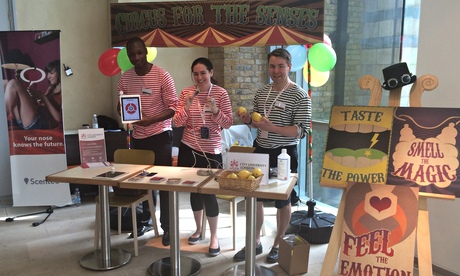
City University staff modelling the Scentee app, ‘digital lollypop’…and some lemons. Photograph: City University

Adrian David Cheok, professor of pervasive computing at City University, London, featuring the phone that wakes you up to the smell of bacon

Tell me about your research
“We are trying to bring all the five senses to the internet, so we can transmit and communicate in a multisensory way.”

OK, so how does it work?
“We have a device called Scentee which you attach to your mobile phone. What it does is emit a puff of scent, such as bacon, coffee or lavender, (using chemical cartridges) when you send someone a text message. We have similar devices to produce taste using only electrical current. So if you’re cooking, you can send the taste and smell of your cooking to all of your Facebook friends. We are also looking at touch technology, making devices like RingU, where you connect your ring to the internet via your mobile phone. You can be thinking of your friend, who might be anywhere in the world, and squeeze your ring and they will then get a squeeze on their finger.”

Why should the public be interested in your research?
“Currently the internet is very much about audio and visual communication. But the sense of touch, taste and smell are very important in our physical communication – these senses are connected to the limbic system of the brain which is responsible for emotion and memory. So when you’re chatting online or Skyping, you actually lose a lot of the human emotion. We want to bring these senses to the internet so in the future you will be able to have a sense of presence.”

What are the challenges you face?
“There’s a saying that in the 21st century the most valuable research is time, because now with the internet we basically have infinite information. Yes, time and funding are very important, but you need to have some creativity. You need to have students who are willing to not do incremental work, but what I call quantum step work. In the atom the electrons will fly around in the one band, but that is incremental work. What you need to do is jump to the next quantum gap. We need to have young people who will become scientists and engineers, but it’s really great during education if they are exposed to the creative arts and other fields so they can understand creativity and design.

“We have to remove the barrier between academia and the public, and if you don’t, it is the universities that are going to suffer, because knowledge is going to become more and more free – and you are seeing this now with things like Ted talks. Universities and researchers have to keep up with the internet age and that’s very important to survive in the 21st century.”

What excites you about research?
“I want to invent completely new technology and push the barrier of knowledge. People might think it is really wacky or crazy at the time, but then when you can show them that it really works, you can get a lot of very positive feedback. The most important thing to do is to be totally original.”

Smell the Coffee with the Next Wave of the Internet

http://newsroom.cisco.com/feature-content?type=webcontent&articleId=1402898

, April 07 , 2014

Will touch, smell and taste be part of the Internet of Everything experience? The ‘pervasive computing’ department of a UK university recently launched a mobile app capable of transmitting aromas remotely, paving the way for a new era of multi-sensory digital communications.

chatperf

Experts have plenty of ideas about what will constitute the next wave of the Internet and mobile communications. But in the ‘Pervasive Computing’ department of City University London  in the UK, Professor Adrian Cheok and his team are certain this will involve a fuller sensory experience – involving smell, taste and touch.

It is a future that is already starting to take shape. In late January, Professor Cheok took his department’s technology to the world-renowned Madrid Fusion culinary festival in Spain, where he unveiled a mobile device and app combination – Scentee – which is capable of emitting food flavors. The technology, developed with a partner in Japan, is believed to be a world first.

Because of the context of the launch, the emphasis at the Madrid festival was the potential for chefs to showcase more of what they do to potential customers – above and beyond photos of their dishes which rarely do their creations justice. But Cheok notes that this is just a glimpse of what’s possible.

‘Wish you were here’

Cheok’s background is in augmented reality – the type of technology we’re seeing now in innovations such as Google Glass. But to achieve a rich simulated reality you need to go beyond audio-visual media, he says. This is also the next area of potential for the Internet, he claims.

“Smell, taste and touch are important means of communication,” Cheok explains. “As we move beyond the ‘information age’ to an era of sharing experiences, what we want to do is give others more of a sense of ‘being there’.”

That means being able to smell the coffee, taste the ice-cream, and feel the touch of another person. Cheok’s innovations include ‘huggable pajamas’, “so parents/grandparents and kids can feel each other’s presence from opposite sides of the world via the Internet,” he explains. A more practical, scaled-down version of this is a wearable ring – RingU – that can remotely transmit a squeeze to a loved one’s hand (via a Bluetooth 4.0 connection to a smartphone). “Touch is so important for communication, and for times when you can’t take a call, receiving a reassuring squeeze via the fingers can mean a lot.” Remote ‘kissing’ applications are further areas of exploration.

Taste and smell, meanwhile, are important because they are attached to the limbic system and associated parts of the brain that are responsible for emotion, mood and memory. The ability to simulate these sensory experiences at distance has great potential in all sorts of applications, from in-store advertising (for example, assigning wafts of scent to frozen food aisles – of what a product would smell like when cooked), to the use of smell as a memory trigger (with potential use for Alzheimer’s patients, and so on).

Emotionally wired

So how does it all work? At this stage the technology is pretty crude, but undoubtedly this will be refined in future iterations, once the mechanics have been perfected.

In a taste scenario, a device with electrodes is used to stimulate taste neurons and taste sensations on the tongue, activated by digitized information sent over the Internet (as chemicals themselves can’t be transmitted). Smell, which continues to be a work in progress, is the subject of similar projects, this time applying magnetic fields to the back of the mouth to stimulate the olfactory receptor, again without chemicals. In the case of Scentee, the smelling device is a bit like an inkjet printer, containing sachets of scents, triggered by a smartphone app.

Cheok sees potential for a fuller sensory experience in TV, cinema and art as well as ‘emotional’ advertising, medical applications, and remote interpersonal communications. The gaming world will undoubtedly be keen to embrace it too – creating even deeper immersion experiences where players are able to smell the burning rubber during a car chase.

He says his university department in the UK is one of only a few groups of computer scientists globally to be looking seriously at multi-sensory media today. The City University London Pervasive Computing faculty combines several disciplines, from electrical engineering (Cheok’s background), to neuroscience.

Cheok has connections to a team in Japan which is doing related work. In particular, a professor in Tokyo is working on new kitchen utensils that can alter the taste of food, for example to artificially make a dish appear sweeter or saltier – without the need to add the actual ingredient. With growing pressure on families and food producers to reduce levels of sugar and salt, this could be a development with both positive health implications and considerable commercial mileage.

Used with the permission of http://thenetwork.cisco.com/.

New digital smell technology transforms smartphones into smell-o-phones

cbsnews

http://www.cbsnews.com/news/new-digital-smell-technology-transforms-smartphones-into-smell-o-phones/

By ALPHONSO VAN MARSH, CBS NEWS

April 1, 2014

When communicating online, words sometimes just aren’t enough, says City University London Professor Adrian David Cheok.

Now, he has a solution: researchers at his Mixed Reality Lab on campus are coming up with ways to say it with a smell — developing cell phone apps and plug-ins that emit scents like flowers, food and spices.

“Smell is a very powerful, powerful sense. It can trigger an emotion or memory at a subconscious level — before we logically think about it,” Cheok tells CBS News.

The lab has already created technology able to send the smell of flowers to a loved one via text — provided the recipient has a special digital device plugged into the earphone jack of their smartphone.

The first application of this technology was the Hana Yakiniku plug-in released in Japan last year. It became available internationally on Amazon in February. Thevideo marketing the Hana Yakiniku attachment presents hilarious digital smell solutions to common problems: the poor college student, for example, who can now dine with his iPhone and sniff beef-scented cartridges of the meat he can’t afford, while eating plain rice for lunch.

The plug in sells for about $35. Refill cartridges come in scents like lavender, coffee, and rosemary — oddly, though, there are no refills for the scent of meat, as advertised in the video. The refills cost about $5.

The technology can be used in a range of commercial applications, from diet programs, advertising and health care, to cooking recipes and personal communications.

“You can send someone a Facebook message, but instead of just putting you are ‘feeling happy,’ you’ll also have the floral smell,” Cheok says.

“For our everyday communication, we want to be able to have a much wider range of experiences being transmitted. Not just sending data, not just sending information — we want to share our experiences,” he adds.

Kraft Food’s Oscar Mayer brand is embracing new smell technology. Its Wake Up & Smell The Bacon internet campaign and giveaway of bacon-scented iPhone plug-ins is going viral. The dream-scape concept video features a woman waking up to the smell of bacon wafting from the device, which can be set to go off with an iPhone’s alarm clock. The official YouTube video racked up more than a half-a-million hits in less than a month.

“People never get tired of bacon,” says Tom Bick, Sr. Director of Integrated Marketing and Advertising for Oscar Mayer. “[We’re] thrilled…to give bacon aficionados a new reason to welcome their morning alarm clocks.”

Oscar Mayer says they’ve received more than 148,000 applications online to receive one of “a few thousand” free plug-in bacon-scent cartridges, which are good for about 100 uses.

When CBS News informally surveyed Londoners, showing them the floral-scented plug-in device attached to an iPhone, reviews were mixed.

“First I thought it was a microphone, because it kind of looks like one. But yeah, it does smell a bit like air freshener,” said Dario Medina, a student from Spain.

But Londoners Gaya Pathma and Allen Koshy seem more impressed by the technology involved than by the smell.

“Just because it is new and different right now, it might be just weird at the moment,” says Koshy. “But once it becomes a trend or something, it will be just fine.”

“It is a scent coming out of a phone. It was a bit scary, but really nice,” Pathma says.

Follow Alphonso Van Marsh on Twitter: @AlphonsoVM

© 2014 CBS Interactive Inc. All Rights Reserved.