The Mixed Reality Lab (MXR) aims to push the boundaries of research into interactive new media technologies through the combination of technology, art, and creativity.
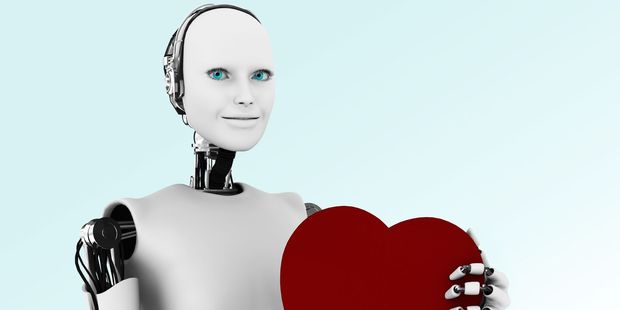
Human-robot marriages may become commonplace by 2050 if not before. Photo / 123RF
On the surface, Lilly seems like a blushing young woman ready to marry the man of her dreams who makes her “totally happy.”
Only her partner is 3D printed robot named Inmmovator who she designed herself, after realising she was attracted to “humanoid robots generally” rather than other people.
“I’m really and totally happy,” she told news.com.au over email in her tentative English. “Our relationship will get better and better as technology evolves.”
The “proud robosexual” said she always loved the voices of robots as a child but realised at 19 she was sexually attracted to them as well. Physical relationships with other men confirmed the matter.
“I’m really and only attracted by the robots,” she said. “My only two relationships with men have confirmed my love orientation, because I dislike really physical contact with human flesh.”
She has since built her own dream man with open-source technology from a French company, and has lived with him for one year. They are ‘engaged’ and plan to marry when robot-human marriage is legalised in France.
The unconventional relationship has been accepted by family and friends but she said “some understand better than others.”
She won’t reveal whether they have a sexual relationship and is currently in training to become a roboticist in order to take her passion into her everyday life.
While Lilly’s views will strike many as odd, it’s just a sign of things to come according to David Levy.
The chess whiz and authority on Love and Sex with Robots said he expects human-robot marriages to become commonplace by 2050 if not before.
Speaking at the second conference on the issue held in London this week, Mr Levy told a room filled with academics and interested people that advances in artificial intelligence mean robots could become “enormously appealing” partners within the next few decades.
“The future has a habit of laughing at you. If you think love and sex with robots is not going to happen in your lifetime, I think you’re wrong.”
“The first human robot marriages will take place around the year 2050 or sooner but not longer,” he said.
The conference explored a host of issues on the subject including everything from what robots should look like to whether they should be able to “learn” about sexual preferences and feed back information to companies behind them.
University of London Computing Professor Adrian David Cheok said he believes robots will not only become common, but preferable for many people.
“It’s going to be so much easier, so much more convenient to have sex with a robot. You can have exactly what kind of sex you want. That’s going to be the future. That we will have more sex with robots and the next stage is love … we’re already seeing it.”
“Actual sex with humans may be like going to a concert. When you’re at home you can listen to Beethoven’s ninth symphony, it’s good enough and once or twice a year you’ll want to go the Royal Albert Hall and hear it in a concert hall.
“That may be the way sex with humans is going to be. It’s going to be much more easier, much more convenient to have sex with a robot, and maybe much better because that’s how you want it.”
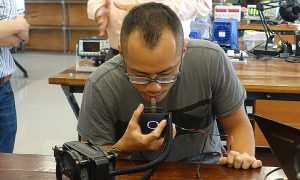
A man experiments with the Taste Buddy, which emits thermal and electric signals to stimulate the taste buds. Photograph: Professor Adrian Cheok/PA
The time has come to loosen our grip on reality. All the signs are there. Millennia of booze and drug abuse, hundreds of conflicting religions and cults and superstitions and alternative medicines and conspiracy theories, the premise of the Matrix franchise, the internet, sunglasses, video games and the powerfully convincing anti-intellectualism of Michael Gove. They’re all saying the same thing: ignore what’s really happening and you’ll feel a lot better. It’s been staring us in the face: we need to close our eyes to what’s staring us in the face.
And there’s been a huge breakthrough in this direction. They’re calling it the “Taste Buddy”, but that’s because they’re awful and cheesy and the less we have to perceive their existence, the happier we’ll be. And the Taste Buddy will help separate our perceptions from that sour reality. Particularly our perception of cheesiness, which we should soon be able to precisely regulate using a computer.
The Taste Buddy, which was unveiled last week, is a new invention, still in its prototype stage, that changes our sense of what things taste like by emitting thermal and electric signals that stimulate, or rather delude, the taste buds. Currently it can only make things seem saltier or sweeter than they are, but the team behind it, led by Adrian Cheok of London University, believes that, with development, it could go much further. If built into pieces of cutlery, it “could allow children to eat vegetables that taste like chocolate”; it could make tofu taste like steak; basically, it could make healthy things taste like delicious things.
“But healthy things are delicious!” you may be saying. And therein lies the problem. Not that healthy things actually are delicious – that’s patently not true. Sometimes it might seem like they are – nuts, for example, often give this impression – and then you discover the deliciousness is all because of some salt or sugar or duck fat that’s been added in cardiovascularly hazardous quantities. Healthy things are delicious if either a) they’re deep fried, or b) there’s nothing else to eat. Couscous salad is much better than no food at all but, on the modern culinary battlefield, it’s a mere flint-headed arrow to the state-of-the-art cruise missile that is a fried egg sandwich.
No, the challenge for the Taste Buddy is not that lentils actually are tastier than chips, but that some people say they are and, in some cases, come to believe it. Their own mental powers of self-delusion rival Taste Buddy’s thermal and electric trickery. And that’s because many people define their identities by their eating choices.
Whether consciously or not, some healthy eaters’ healthy eating is primarily an expression of control, cleanliness and virtue. It doesn’t just make them feel better, it makes them feel better than other people. If eating steamed broccoli is suddenly no hardship, because it can be made to taste like baked Alaska, they’re going to be deeply offended. It would be like offering a devout order of self-flagellating monks an inexhaustible supply of local anaesthetic.
Frankly, Taste Buddy will be seen as cheating. These penitents won’t like it that those of us with coarse, lifespan-reducing palates will get the benefit of nutrients we haven’t earned, now that gruel is no longer gruelling. A market will immediately open up for some scientists to discover that it’s actually tasting the lettuce rather than swallowing it that matters most.
The most rabid salad eaters and the haute cuisine sector will combine to incentivise anyone who’ll claim “there are still no shortcuts” when it comes to eating well, that the brain needs the taste of roughage, or just that Taste Buddy might give you tongue cancer. Which, I suppose, it might. As might a sexist joke on a lolly stick.
And maybe they’d have a point. A spoonful of sugar may help the medicine go down, but it probably screws up the placebo effect. Who knows how crucial those feelings of sacrifice, self-denial and moral superiority (lost for ever if Taste Buddy turned everything delicious) actually are to the health-enhancing powers of a balanced diet. In a carefully conducted study, it could probably be measured. But that sounds rather elitist, doesn’t it? Measuring things with cold objectivity, as if that can ever matter as much as a sincere conviction of the heart.
If you think that’s all a bit touchy-feely, or tasty-thinky, you may be surprised to learn it’s an approach Theresa May is very keen on. Last week the Times reported that the Home Office was concealing a report it had commissioned into the number of foreign students who break the terms of their visas and remain in Britain illicitly after their courses have finished. The number the report had come up with was about 1,500 annually, rather than the tens of thousands that had previously been estimated and generally bandied about. That was not what the Home Office, or the prime minister, wanted to hear.
Why not? It’s good news, isn’t it? Well not if you’ve just cracked down on the admission of foreigners to British universities, with potentially disastrous consequences for the latter’s funding. The notion that this drastic policy might have almost no effect on reducing net immigration was extremely unwelcome and, the government clearly felt, best kept quiet.
Particularly as, among likely Tory voters, there’s a broad perception that foreign students stay here and scrounge. Many people feel that feckless young foreigners are dragging us down and the government has come up with a harsh little policy to address that. Why let the fact that it’s not true get in the way?
Surely, Theresa May must think, it’s not the business of government to start telling the public it’s wrong. In an increasingly virtual world, feelings are as valid as facts. Let’s focus on what people perceive to be the case and concentrate on adding to that a perception that something is being done about it. That’s efficient democratic accountability for post-truth Britain.
No need to contradict people about what they reckon is going on, denying problems they believe exist and citing others they were previously untroubled by. Policy doesn’t need to reflect reality any more than the currency needs to be backed by gold. Just listen to their fears, confirm them and then use them to make the government seem vital. People will swallow anything if you control how it tastes.